Showing posts with label reconstruction. Show all posts

Wednesday, August 13, 2014

Grilling the Mycenaean Way ~ Experiments with a Souvlaki Tray

Last week when perusing the merchants at the Pennsic War, I came upon a potter, Anne L. Carenbauer of Nonna's Mugs and Jugs, who had made a reproduction of a Mycenaean cooking tray of a type archaeologists speculate was used for cooking the ancient versions of souvlaki or kebabs. I've been interested in finding one to experiment with for a while and asked her the price. She replied that she had made a second one which had cracked when she used it, so she was uncomfortable selling it to me, but that I was welcome to borrow it and try using it if I would report back to her the results. I scuttled back to camp clutching my prize....
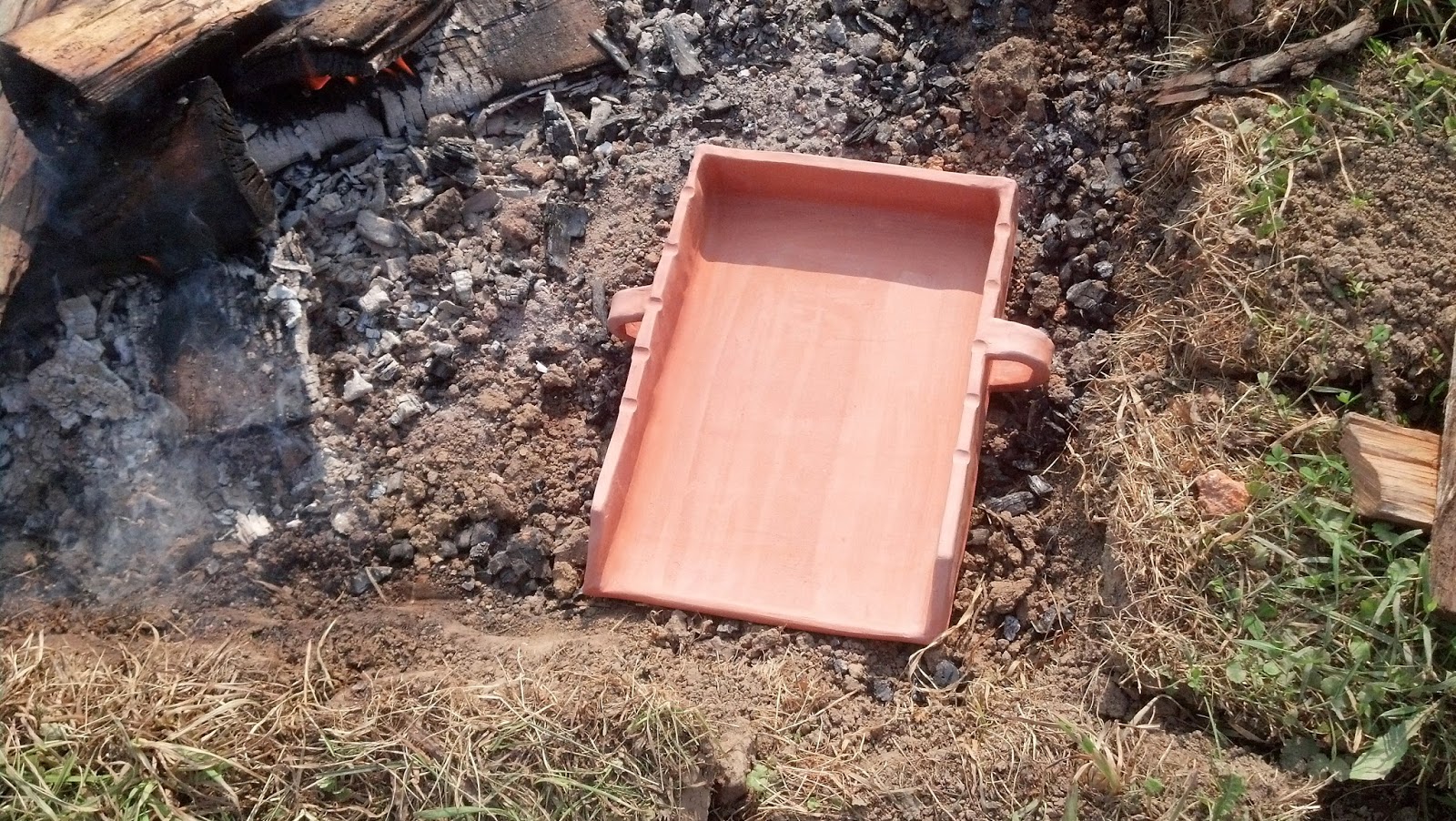
The tray prepared and ready to go.
I am experienced with open fire cookery in clay so I soaked the tray for about a half hour as I would with other crockery, prior to warming it slowly by the fire. I had previously started a good fire which steadily produced coals throughout the cooking time. I made a flat place in the fire pit for it to sit, however in retrospect I might have been better off having it out on the grass beside the pit, as it would have been subjected to less heat from the coal making process. We had gotten some chicken and beef for the communal dinner that night but I also bought some lamb for a first round of experimentation before the main event, just in case there was a terrible failure. FYI Pennsic shoppers, the lamb came from the Cooper's store and was from a local farm.

The meat on one bowing skewer.
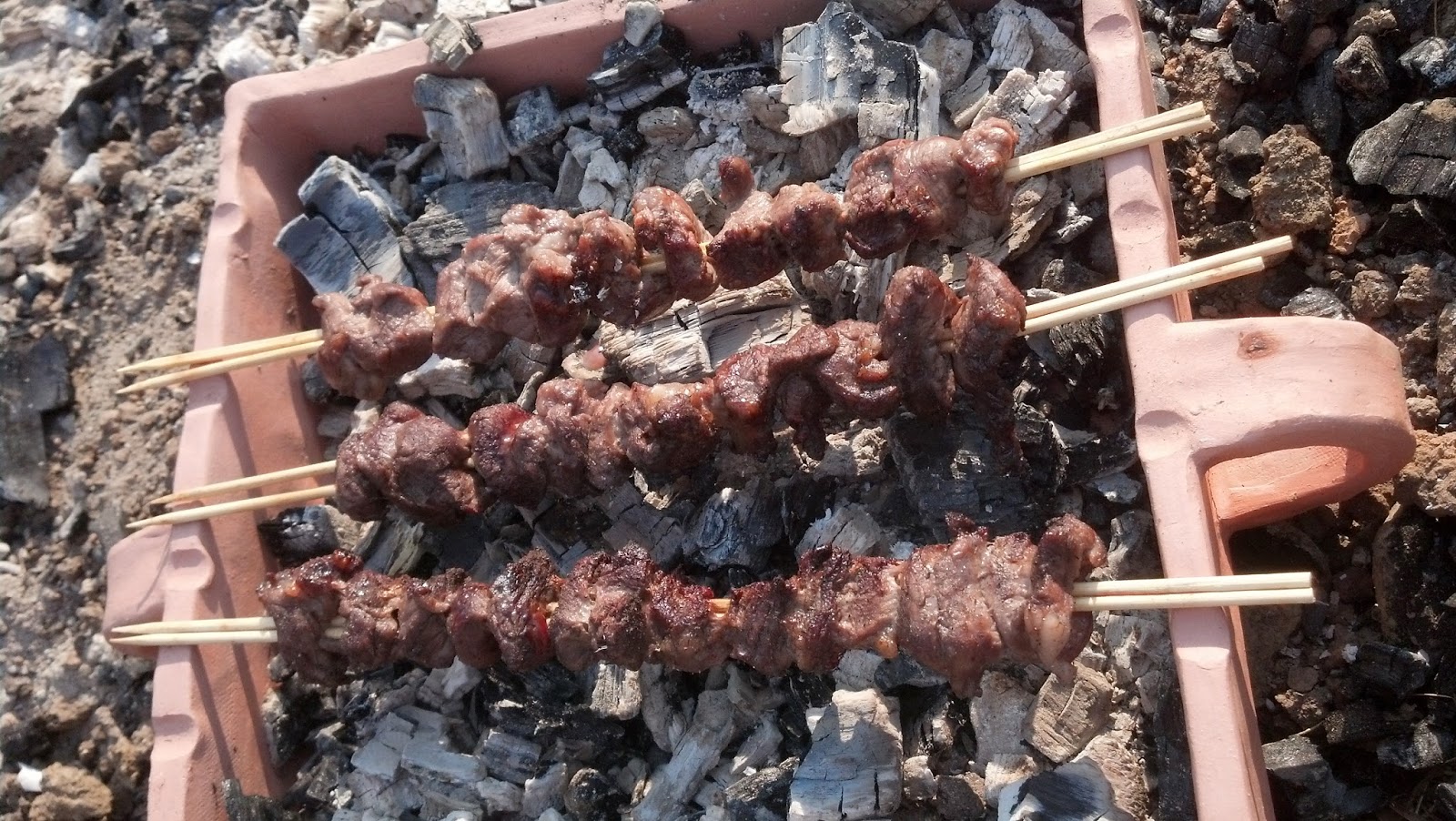
To prepare the lamb, I cut it up into small pieces, no more that an inch square, and marinated it in a mixture of cider vinegar, red wine, salt and pepper for about a half hour. Then I put the morsels on bamboo skewers and shoveled coals into the tray. The first thing I discovered after I had put them on was that one skewer is not strong enough to support all that meat so I immediately pulled them off and inserted an additional one. Having two skewers also created stability so that the skewer of meat did not turn when it was placed over the coals. The meat cooked faster than I had expected. Although I didn't time it, I would guesstimate that it cooked in about 10 minutes. It was crispy but not burned and had a pleasant, slightly smoky flavor. 

A skewer of cooked lamb.
Aren't you hungry?
The cooking continued until the lamb was all done and then I turned my attentions to the beef, which I prepared in the same manner. Between meats, I stirred the coals around and with a blowpipe blew out the ash (there wasn't very much), then I added more coals from the feeder fire. The beef cooked well, but part way through I heard the telltale 'pink' of cracking redware, then as I cooked a large crack opened up on the left side of the tray. I finished the beef and again cleaned out the tray and added more coals to cook the chicken. This gave me a chance to see what was going on, and as it turned out, the crack did not go all the way across the tray. The chicken was cooked and the meat enjoyed by all the diners. 

Feedback
In Minoans and Mycenaeans: Flavours of Their Time by Yannis Tzedakis and Holley Martlew, the authors make the point that these trays were made of unfired ceramic which presumably would fire a certain amount as they were used. I don't know if that would give them more 'flexibility' but it would be interesting to try cooking in an unfired tray. Alternatively, the trays could have simply been used until it became unusable and discarded for a new one. Even if the end had broken completely off this tray, I could have cooked four skewers of meat without a problem.

Besides the book mentioned above, interested readers should seek out the work of Dr. Julie Hruby of Dartmouth College. She has written extensively on Mycenaean foodways and performed cooking experiments with reproduction cookware. You can find an article of her's online here, and I would direct your attention to her discussion of souvlaki trays on p. 154. She was featured in the Valley News in June and on NPR.
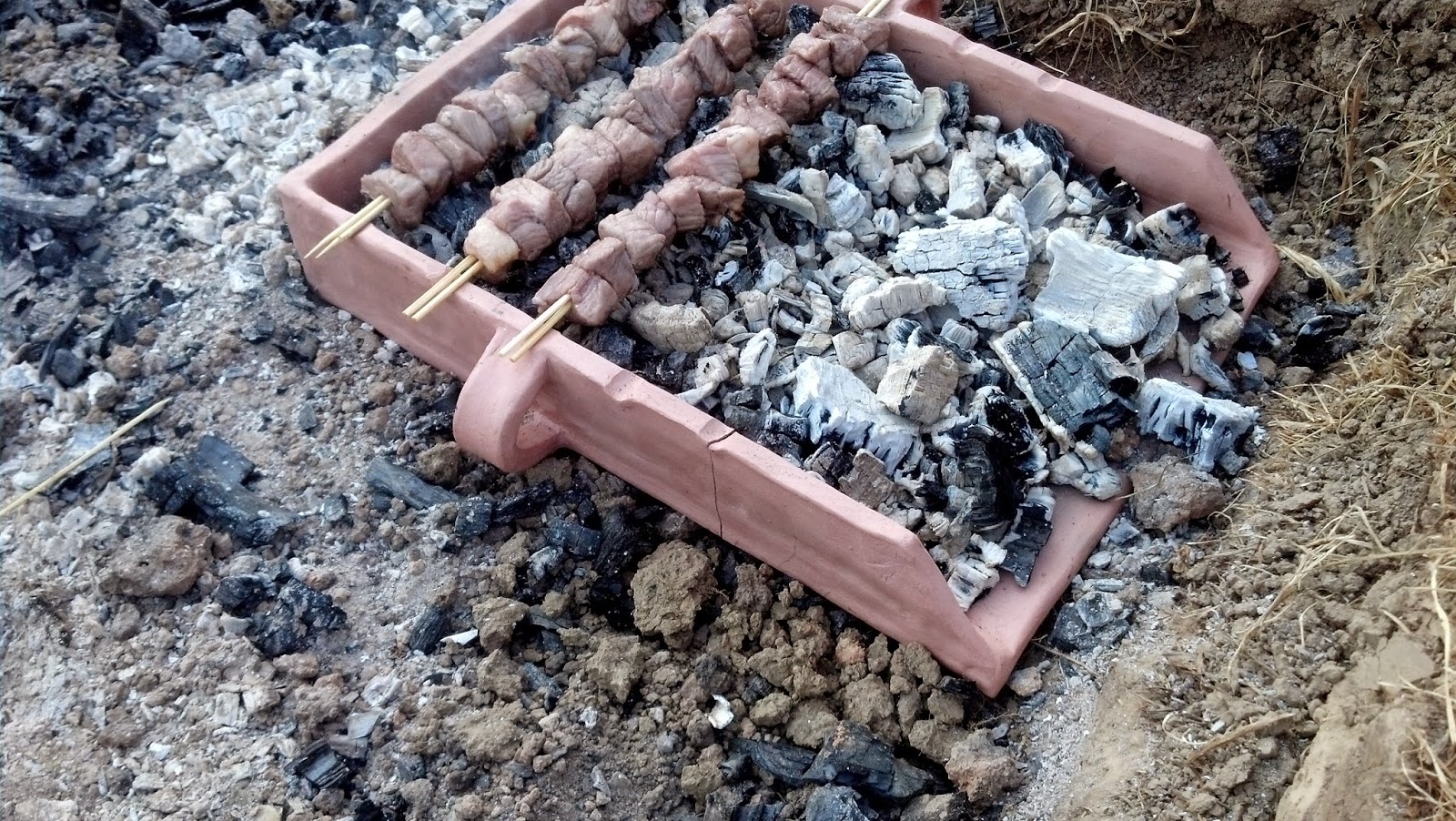
Note the size of the crack.
Trays need to have high enough sides to accommodate both the coals and the meat. The sides on this tray were about a centimeter too low and the meat ended up resting directly on the coals. It didn't burn it but you had to pick the hot coals off when you removed the meat. 

I think what happened with the cracking was the front of the tray flexed downwards as it became hotter. When it was cooking and at its hottest, the gap at the crack was at least a millimeter but after it had cooked the ceramic returned to its previous position. 

Other ceramic cookware which I have used for open fire cookery has had a clay body quite high in grog. This seems to help with thermal issues and might also make the piece somewhat more flexible. Its something to consider for future trays.  

I had a lot of fun cooking in this tray and am grateful for the chance to experiment with it. I'm very interested in trying an unfired tray to see what differences there might be, if any, in the behavior of the ceramic. Below are the rest of the photos we took that afternoon. 

Ready to receive meat!
After a second skewer as added.

More lamb on the coals.
Raking the coals with a stick.

Blowing the coals with the blowpipe.
Lamb cooking.

Note how crispy it is on the edges.
Yum!

Cut up beef. It should be small.
Cooked beef.

Preparing to add chicken, note the crack.
Coals added for the chicken.

Chicken on the coals.
Chicken after a few minutes.

Detail of the crack.
Overall view of the tray.

Wednesday, June 25, 2014

Dressing the 1580s

I've been missing the sixteenth century quite a bit lately. Not that I am the least bit fed up with my Dura studies, there is still so much to learn there, but I've heard about a couple of 16th century in-persona events recently which have really made me pine for that time period. One thing holding me back from going though is a complete lack of wardrobe which set me looking at images of late 16th century dress in preparation for making more.

I've been looking especially at several engravings of captains from the early 1580s and today had some revelations about fit and construction, ones that were hiding from me in plain sight.

1. The doublet needs to be made first because all the rest of the ensemble hangs off of it.
2. The hose need to be built to suspend from the doublet. The attachment can't be an afterthought.
3. In the 1580s everything was a unit, no separates!
4. Everything is rather larger than one's actual body size. I've been making my outfits pretty close fitting previously, but because it is all attached to each other as a unit it needs to have more ease. The suit is built around one but I've been making things just too close.

It probably seems self evident but it felt like I had a revelation in terms of viewing the suit as a unit not separate garments.

These are the two captains who set me musing. Note how much underpinning both the doublet and Venetians have and that they are suspended as a unit. The legs of the Venetians are just the correct length, they do not droop, and they are interlined to hell and gone as evidenced by the fact that the sword belt is not being pressed in to the fabric very far. Ditto for the interlinings on the doublet. If we had x-ray glasses and could see their bodies inside, I think we would be surprised to see how slenderly built they were, not fat, but also not heavily muscled either. You wouldn't realize that from their outward appearance!

So those are my thoughts, now I need to get sewing!

Wednesday, August 24, 2011

Seeing what you're looking at

I have, for some months, had a rotating series of military engravings by DeGheyn and Goltzius as the screensaver and desktop on my work computer. This has afforded me the chance to study the costume and weapons depicted in great detail and I've come to the conclusion that I need to re-examine any previous assumptions I might have had regarding military dress of the 1580s and 90s.

To this end I decided start with the most basic item of male dress in the period, the shirt. We have owned a copy of Patterns of fashion 4 : the cut and construction of linen shirts, smocks, neckwear, headwear and accessories for men and women c.1540-1660, conceived & illustrated by Janet Arnold. Quite Specific Media Group, c2008, pretty much since it was published but aside from browsing through it, I hadn't sat down to really study the garments. When I finally go around to taking a look, I found several shirts which were spot on in terms of dating (as much as one can actually date garments of this period) and of roughly similar dimensions. In addition there is a shirt of Gustavus Adolphus which can firmly dated to 1627. Although it is more recent, it has some similarities to shirts being worn by military men of 40 years earlier, especially in size and ornamentation of the collar and cuffs which could be worn simply turned over the doublet collar and sleeve cuffs. They are small enough though for a separate ruff and wrist ruffles to be pinned on over them.

Needless to say I have been reflecting quite a bit about Luke's shirt supply - how many did he own - where did he procure them from, etc., etc. When he was a boy and up though the time he went into service, his Mother, sisters and his Mother's maids would have made his shirts. While in Norreys' service he would probably have gotten some of his shirts as part of his livery with the remainder coming from home. Then later after he was on his own with his own men and military establishment he probably would hire a seamstress in London to make him the bulk of his shirts. His Mother still makes him some shirts and they are beautiful examples of the needlewoman's art.

I decided to model the shirt I was going to make on numbers 10 and 12 from Patterns of Fashion. Both are from the last quarter of the 16th century and are of similar dimensions. The originals were quite long, shirts could be used for sleeping and receiving visitors in one's bedchamber and we have no way to know if these shirts solely served that purpose but had I made them to their actual length, I would be tripping over the bottoms. They also were wrapped about one's nether regions and did the office of jockey shirts of the day. I decided to shorten the shirt to my shins, still plenty long but not so much that I would fall on my face. They are both highly decorated and with reluctance I am dispensing with most if it, save for some bobbin lace edging around the collar, front opening, cuffs and hem. I feel like I want to get a good pattern worked out to fit me well before expending the time and effort on a highly ornamented shirt. I have cut out the fabric and will begin turning and sewing down all the edges. When that's done, I'll try to remember to post again with an update on my progress.

Monday, April 5, 2010

Writing Tables

Wednesday viij. February 1586/87. "...out to the stationer to have some notebooks made and then to Mr. Adams to have two sets of writing tables made, one with an almanac and the other without, both to have leather covers, and the covers to be made so they might keep out the damp better than that I did have of him last year..."

In this passage from his journal, Luke goes to the stationer and orders up some additional notebooks for his journal, accounts and other notes. He then goes to Franke Adams, one of several manufacturers in London in this period, and has him make some “writing tables.” He is not buying furniture, rather he is buying what was at the time (1587) fairly new technology for writing. The “tables” were coated paper/card stock that might be written on with ink, black lead (graphite) or silverpoint and then cleaned off and used again and again. Luke might write his journal entries directly into a notebook, but more often he would use the tables as a temporary scratch pad and then make a fair copy later in his notebooks.

Peter Stallybrass has written an excellent article on the subject which appeared in the Shakespeare Quarterly. The writing tables were quite small, about the size of a deck of cards, like the example at Houghton Library of Harvard University. They were bound with a multi-year almanac, perfect for the businessman on the go, and made up of paper/card stock coated with gesso and shellac. I would expect that the stock itself would need to be substantial because gesso is by its nature very prone to cracking and flaking on a flexible surface, but that might not be the case. I expect also it would want to have quite a high glue content to really bind it all together. The tables came with erasing instructions in some of the earlier editions and the owner is warned not to allow the just cleaned tables to rest against each other when they are wet, suggesting a tendency towards stickiness.

I plan to conduct some experiments to determine the composition of the coating and I will be writing to Professor Stallybrass for any advice he might have on their construction. I will also need to get over to Houghton and take a look at the example there. Then I will have to make some and see how they actually work.

Stallybrass, Peter; Chartier, Roger; Mowery, j. Franklin; Wolfe, Heather. “Hamlets Tables and the Technology of Writing in Renaissance England,” Shakespeare Quarterly, Vol. 55, No. 4 (Winter, 2004), pp. 379-419.